

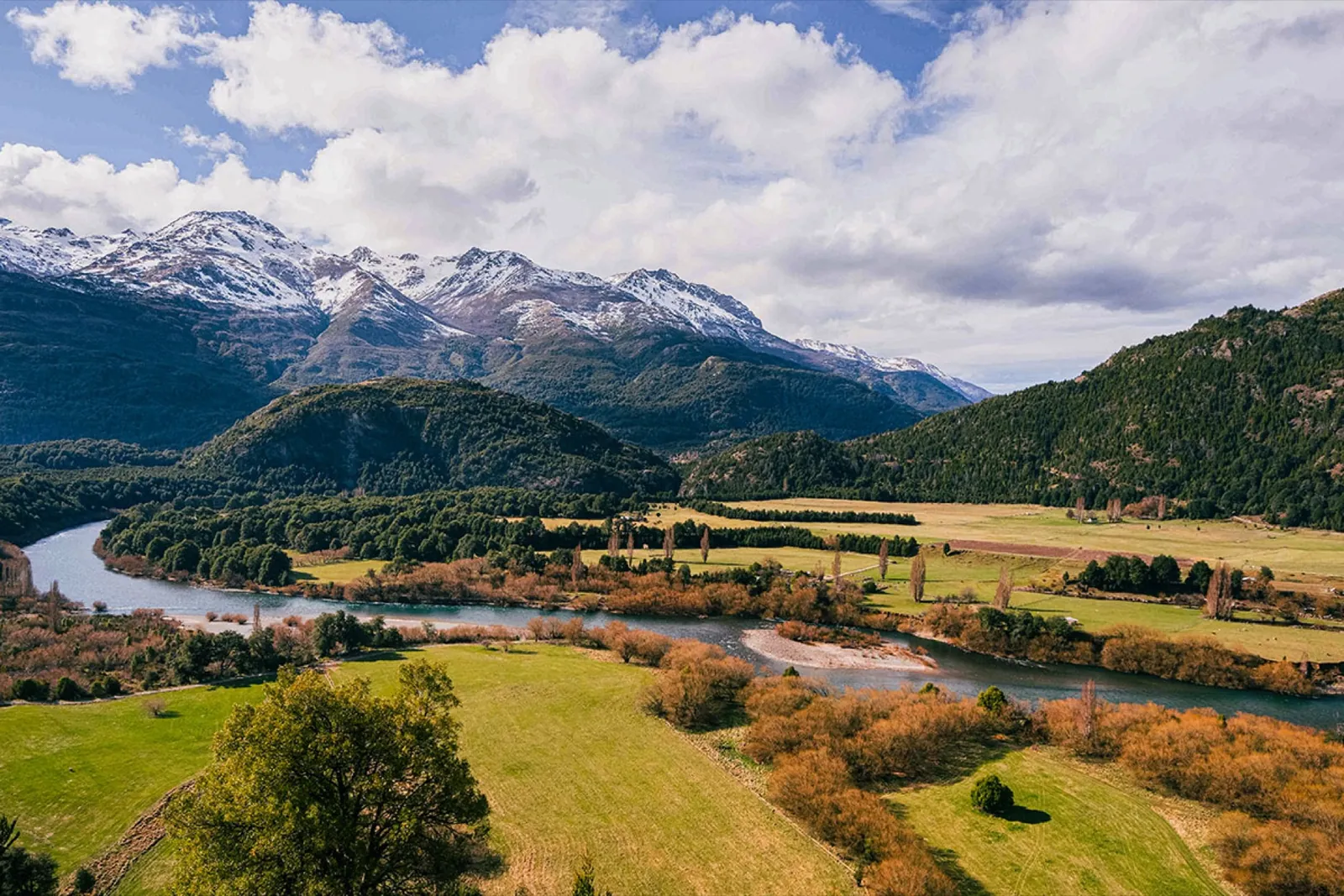
Guide · February 2027
The February 6, 2027 Annular Eclipse in Futaleufú, Chile
Seven and a half minutes of ring of fire over the valley, a few miles from the centerline.
On Saturday, February 6, 2027, the Moon will pass straight in front of the Sun without quite covering it. For a few minutes a bright ring will surround its dark disk: the "ring of fire" of an annular solar eclipse. The path of annularity crosses southern Chile and Argentine Patagonia, and its centerline runs about 4 miles (7 km) from Uman Lodge in Futaleufú.
This guide covers what an annular eclipse is, where the shadow goes, when each phase happens in Futaleufú, the February weather odds, how to watch without hurting your eyes, and what else to do in the valley that week. We computed the numbers from NASA's official eclipse elements and cross-checked them against timeanddate, France's IMCCE and Chile's Los Lagos regional government.
- Eclipse type
- Annular
- Ring at Uman Lodge
- 7 min 31 s
- Maximum (Chile time)
- 11:55 a.m.
- Sun covered
- 86%
The basics
What is an annular eclipse?
A solar eclipse happens when the Moon, at new moon, lines up between Earth and the Sun. When the Moon is near the far point of its orbit, it looks slightly smaller than the Sun and can't cover it: a bright ring is left around it. That's an annular eclipse.
On February 6, 2027, the Moon's disk will be 92.5% of the Sun's diameter, covering 86% of the Sun's area as seen from Futaleufú. The remaining 14% is still a lot of light. The sky won't go dark as in a total eclipse, no stars will come out, and it is never safe to look without a solar filter, not even during the ring.
| Total eclipse | Annular eclipse | Partial eclipse | |
|---|---|---|---|
| What the Moon covers | The whole Sun | The center, leaving a ring | Only part of it |
| Why | The Moon looks as large as or larger than the Sun | The Moon looks smaller than the Sun | The Moon isn't centered |
| The sky | Dark, corona visible | Dimmed, metallic light | Nearly normal |
| Safe without a filter? | Only during totality | Never | Never |
This eclipse belongs to Saros 131, a family of eclipses that repeat every 18 years and 11 days. Its point of greatest duration, 7 min 51 s, falls over the Atlantic off southern Brazil, at 15:59:32 UT (12:59 p.m. Chile time).
The track
The path: from Chile to Africa
The Moon's shadow touches down at sunrise in the South Pacific, near 39° S and 131° W, at 14:07 UT. It reaches South America through Chiloé, Palena province and northern Aysén shortly before noon Chile time. It then crosses Chubut, Río Negro and the Buenos Aires coast, clips Uruguay and the southern tip of Brazil, crosses the Atlantic, and ends at sunset on the Gulf of Guinea: Côte d'Ivoire, Ghana, Togo, Benin and Nigeria.
Near Futaleufú the path is about 180 miles (290 km) wide. Its northern limit runs just north of Castro and El Bolsón, its southern limit near Puerto Cisnes. Outside the path the eclipse is partial. In Puerto Montt, Bariloche or Coyhaique the Moon covers 83–85% of the Sun, but no ring forms.
How long the ring lasts in towns across the region, computed from NASA's Besselian elements. Times are Chile time, which matches Argentina on the day:
| Place | Annularity | Ring begins | Distance to centerline |
|---|---|---|---|
| Futaleufú (town) | 7 min 32 s | 11:51:22 | 2 mi south |
| Uman Lodge | 7 min 31 s | 11:51:23 | 4 mi south |
| Trevelin (Argentina) | 7 min 32 s | 11:52:07 | 2 mi south |
| Esquel (Argentina) | 7 min 32 s | 11:52:27 | 7 mi north |
| Puerto Cárdenas | 7 min 29 s | 11:50:25 | 9 mi north |
| Villa Santa Lucía | 7 min 28 s | 11:50:28 | 9 mi south |
| Chaitén | 7 min 08 s | 11:50:11 | 29 mi north |
| Quellón | 7 min 06 s | 11:48:34 | 29 mi north |
| Palena | 7 min 02 s | 11:51:35 | 32 mi south |
| La Junta | 6 min 27 s | 11:50:44 | 45 mi south |
| Castro | 4 min 24 s | 11:49:50 | 73 mi north |
| Puerto Montt | Partial only (85%) | — | Outside the path |
Where Futaleufú falls
Futaleufú sits right by the centerline
Futaleufú isn't just inside the path; it sits almost on the centerline, where the ring lasts longest and looks most even. The Los Lagos regional government calls it the "epicenter of scientific interest" for the eclipse.
- Centerline: at Futaleufú's longitude it runs along 43°09′ S, about 2 miles (3.5 km) north of town and 4 miles (6.5 km) north of Uman Lodge (43°12′43″ S, 71°51′32″ W).
- Path limits: the northern edge is about 99 miles (159 km) away and the southern edge about 91 miles (146 km). You're deep inside the path, not on its edge.
- Duration: 7 min 31 s at the lodge versus 7 min 32 s on the centerline. Driving to the line gains you under one second.
- Sun position: at maximum the Sun stands 51° high in the northeast (azimuth 54°), well above the surrounding ridges. Still, pick a spot with an open view to the northeast and north.
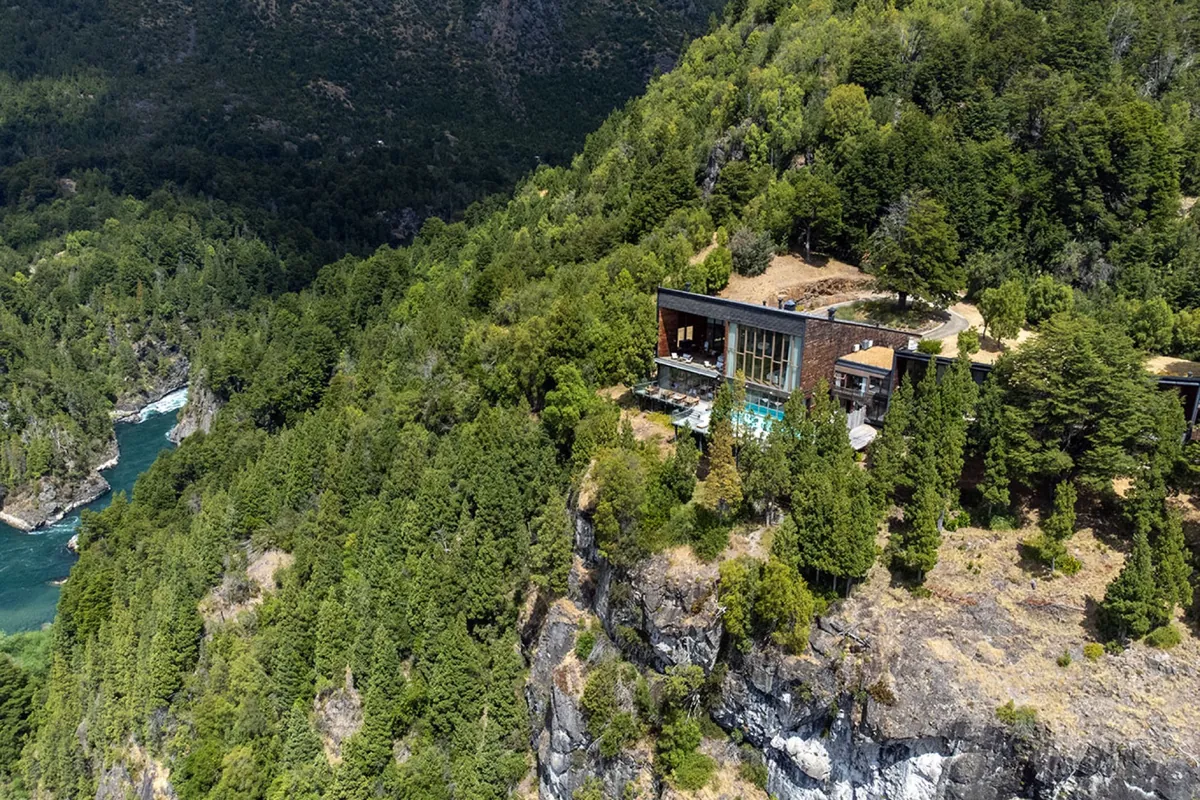
The bottom line: you don't need to travel to see the full ring. The only reason to move on the day is to chase clear sky if clouds sit over the valley (see the weather section).
Timeline
Eclipse times in Futaleufú
These are the contact times at Uman Lodge in official mainland Chile time. Chile is on daylight saving time, UTC−3, from September 2026 to April 3, 2027 (Supreme Decree 98 of 2026). Argentina is also on UTC−3, so clocks read the same in Trevelin and Esquel. That's 8:22 a.m. EST at first contact if you're coordinating with home.
| Phase | Time (UTC−3) | Sun altitude | Direction |
|---|---|---|---|
| First contact: partial eclipse begins | 10:22:30 a.m. | 36° | East-northeast (77°) |
| Second contact: the ring closes | 11:51:23 a.m. | 51° | Northeast (55°) |
| Maximum eclipse | 11:55:08 a.m. | 51° | Northeast (54°) |
| Third contact: the ring breaks | 11:58:54 a.m. | 52° | Northeast (53°) |
| Fourth contact: eclipse ends | 1:34:32 p.m. | 62° | North (14°) |
The whole eclipse lasts 3 h 12 min and the ring 7 min 31 s. Magnitude at maximum is 0.96 in timeanddate's convention (0.925 as a diameter ratio, the figure NASA quotes), and the Moon covers 86% of the Sun's area.
These figures are for a fixed point. Expect a second or two of difference depending on the lunar limb profile and your exact spot. timeanddate gives 10:22, 11:55 and 1:34, with 7 min 30 s of annularity for Futaleufú. Chile's regional government puts the ring "between 11:51 and 11:59". For your exact location, use Xavier Jubier's interactive map or the IMCCE calculator (links at the end).
The experience
What you'll see and feel
An annular eclipse is subtler than a total one, but easy to follow if you know what to look for:
- 10:22 a.m., first bite. Through eclipse glasses you'll see a dark notch on the Sun's edge, growing minute by minute. Without them you notice nothing.
- Crescents on the ground. By about 11 a.m., the shade under a tree fills with tiny crescents of light. Each gap between the leaves works as a pinhole camera.
- The light changes. Once the Moon covers 70–80% of the Sun, the light turns flat and slightly metallic, shadows sharpen, and the air often cools a little. At 86% coverage it's still daytime.
- 11:51 a.m., the ring. The horns of the crescent meet on the far side and the ring closes. From near the centerline it looks almost even. Near the path edges you'd see "Baily's beads", points of light slipping between lunar mountains.
- Seven and a half minutes. Plenty of time to look, take photos, and look again.
- 11:58 a.m., the ring breaks. The Sun turns back into a crescent facing the other way and slowly fills in until 1:34 p.m.
Every solar eclipse falls at new moon, so the nights around February 6 are moonless. With clear skies, they're the best of the summer for the Milky Way over the valley.
Getting there
Standing on the centerline
From Uman Lodge the ring is already essentially as long as it gets. Still, if you want the "on the line" photo or need to dodge a cloud, these are the three roads that cross the centerline closest to the valley. We found the crossings by intersecting the computed centerline with OpenStreetMap road data:
| Where | From Futaleufú | Crossing point | Ring | Typical weather |
|---|---|---|---|---|
| Route W-939, north of town | 3.7 mi, about 15 min (gravel) | 43°09′29″ S, 71°53′34″ W | 7 min 32 s | Same as the valley |
| Route 259 between Trevelin and Esquel (Argentina) | 33 mi, a little over 1 h via the Futaleufú Pass | 43°03′03″ S, 71°27′25″ W | 7 min 33 s | Drier, east of the Andes |
| Carretera Austral (Route 7), between Puerto Cárdenas and Villa Santa Lucía | 57 mi, almost 2 h via Route 231 | 43°17′01″ S, 72°25′08″ W | 7 min 31 s | Cloudier, deep in the mountains |
- Route W-939. It heads north from town and crosses the line within a few miles. It's the simplest option, but there's no weather gain: same sky as the valley. Scout it beforehand and park well off the road. [VERIFY road condition and pull-outs]
- Trevelin and Esquel. Average February cloud drops noticeably on the Argentine side (see the next section). You'll need your passport, and if you drive a rental, the car company's permit to leave Chile. The Futaleufú Pass is open 8 a.m. to 7 p.m. [VERIFY February 2027 hours]. Chilean authorities expect heavy traffic and border pressure that weekend, so leave very early or, better, sleep on the far side. You also trade the valley scenery for a few points of probability.
- Carretera Austral. This is the most accessible Chilean stretch of the centerline from Futaleufú, but satellites record more cloud there than in Futaleufú. It makes sense if you're already driving the route, which our Carretera Austral guide covers.
Distances and times are OpenStreetMap estimates and don't include border lines. On a busy day, expect them to run longer.
Weather
February weather: what are the odds?
February is late summer in northern Patagonia. According to the Chilean Weather Service's 1991–2020 normals, it's the driest month of the year in Futaleufú: about 2.7 in (68 mm) of rain against about 81 in (2,070 mm) a year. Days are mild, with average highs near 66 °F (19 °C) and lows around 46 °F (8 °C), per published station climatology.
Clouds are another story. Jay Anderson, the go-to eclipse meteorologist (Eclipsophile), analyzed 22 years of Terra satellite images taken close to eclipse time:
- Futaleufú: average February cloud cover of 52%, the best on the Chilean leg. The Sun would have been visible on February 6 in at least 15 of 22 years, though often through thin cloud. It rains on about six days of a typical February.
- Chiloé and Puerto Cárdenas: around 63%, with the eclipse visible in 13 of 23 years.
- Esquel: 40%, visible in 16 of 23 years. Farther east on the steppe it drops to 30–35%.
On that record, your odds in the valley run around two in three: better than anywhere else in Chile, a little worse than Argentine Patagonia. Anderson notes that lee-wave clouds east of the Andes often leave clear bands only a few miles wide that may not show up until the last moment.
What to do with that:
- Start watching cloud forecasts five days out, and check again on the afternoon of the 5th.
- If the forecast is poor for the valley and good for Trevelin or Esquel, decide the night before and leave early.
- If there's thin cloud or passing gaps, stay put. The ring lasts seven and a half minutes, and a one-minute gap is enough to see it.
Eye safety
How to watch safely
During an annular eclipse there is no moment when it's safe to look at the Sun without a filter, not even with the ring complete. The 14% of the Sun left uncovered is enough to cause serious eye injury. Follow the guidance of the American Astronomical Society (AAS) and NASA:
- Eclipse glasses meeting ISO 12312-2, bought from a reputable supplier (the AAS keeps a list). Inspect them first and throw them out if scratched, punctured or loose.
- Sunglasses are not safe, however dark: they let through far more light than your eyes can take.
- Welder's glass shade 12 or higher, with 13 or 14 the sweet spot. Never use auto-darkening or adjustable welding helmets.
- Put your glasses on before you look up and take them off after you look away. Keep your regular glasses on and wear the eclipse glasses over them.
- Always supervise children.
- Pinhole projection if you have no glasses: a colander, a card with a hole, or your crossed fingers project small images of the Sun on the ground. Stand with your back to the Sun and never look through the hole.
- Never look through binoculars, telescopes or cameras without a solar filter, even with eclipse glasses on: concentrated sunlight burns straight through them.
Photographing the ring
- Phone: hold or mount a solar filter over the lens for the entire eclipse. Without one, the sensor can be damaged and the ring shows up as a blown-out white dot.
- Camera, binoculars or telescope: use a solar filter on the front of the lens or tube, firmly attached. The AAS warns that filters that screw into an eyepiece are dangerous. Cap the finder scope too.
- Wind: Patagonia is rarely calm. Use a sturdy tripod and a filter that won't blow off in a gust.
- Practice on the plain Sun at the same time of day in the days before.
- Don't miss it: set the camera to shoot on its own and watch the ring through your glasses.
At the lodge
The eclipse at Uman Lodge
February 6 falls in the heart of the lodge season; Uman Lodge welcomes guests from November 7 to March 31. The lodge sits on a 1,200-acre (490-hectare) estate above the confluence of the Espolón and Futaleufú rivers, inside the annular path and 4 miles from the centerline, so you can watch the full ring without leaving the property.
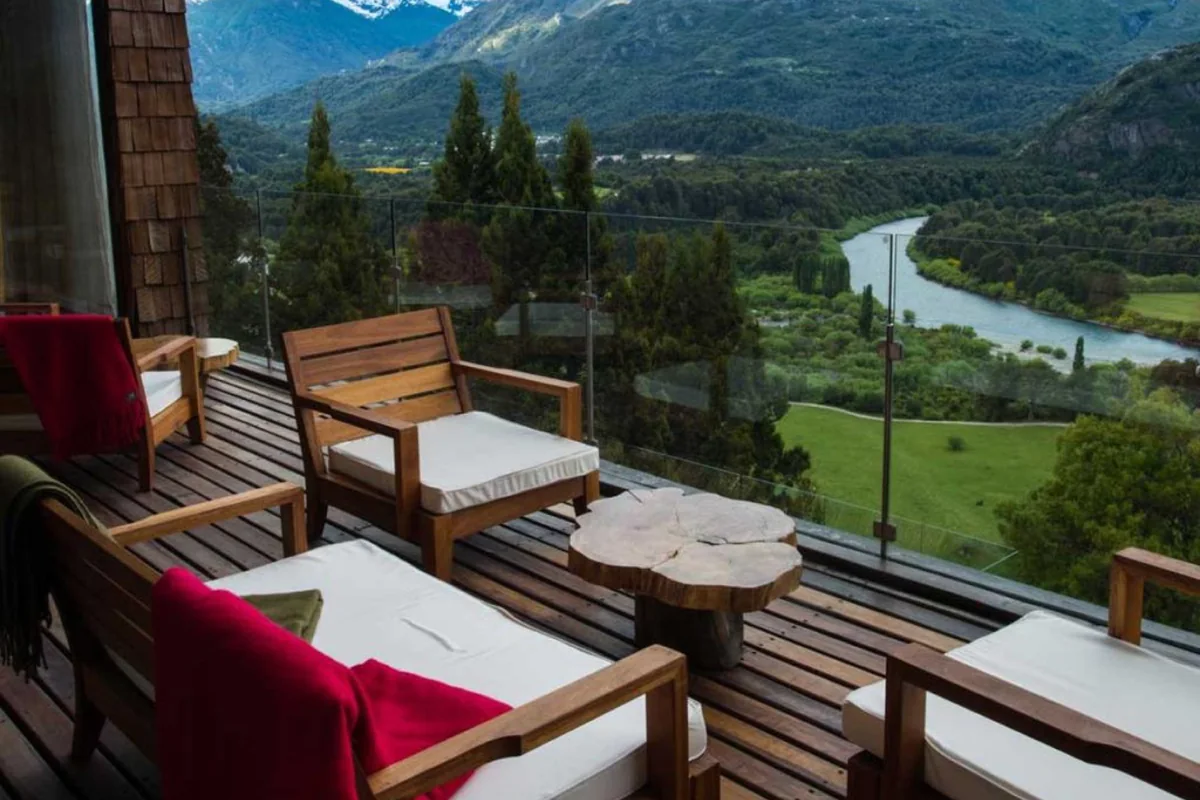
What we're still working out for the day:
- An eclipse-viewing plan at the lodge: where, when, and whether it's included in the rate. [CONFIRM]
- ISO 12312-2 glasses for guests. [CONFIRM]
- A telescope with a solar filter or a talk by a guest astronomer. [CONFIRM]
- A transfer to the centerline or to Argentina if the valley is cloudy. [CONFIRM]
- Minimum stay or special terms for those dates. [CONFIRM]
A big influx of visitors is expected in the district during peak summer season, so if you want to be in the valley that weekend, book early. Activities are run by third-party operators and are best booked along with your stay.
Beyond the eclipse
What else to do that week
The eclipse takes one morning. The valley fills several days:
- Rafting the Futaleufú. February is inside the river's most stable season, December to March, with sections for first-timers and the Class V water that made the river famous. See our guide to rafting the Futaleufú.
- Fly fishing. The 2026–27 season in Palena province runs November 1 to May 2, and summer evenings tend to bring surface activity. You need a Sernapesca license. It's all in our guide to fly fishing in Futaleufú.
- Carretera Austral. Driving down from Puerto Montt or Chaitén? Our Carretera Austral guide helps with ferries, road sections and stops.
- Spa and dinner. After eclipse morning, the heated pool and a long dinner built on produce from the estate.
- Night sky. With no moon, February 5–8 are ideal for stargazing if it's clear.
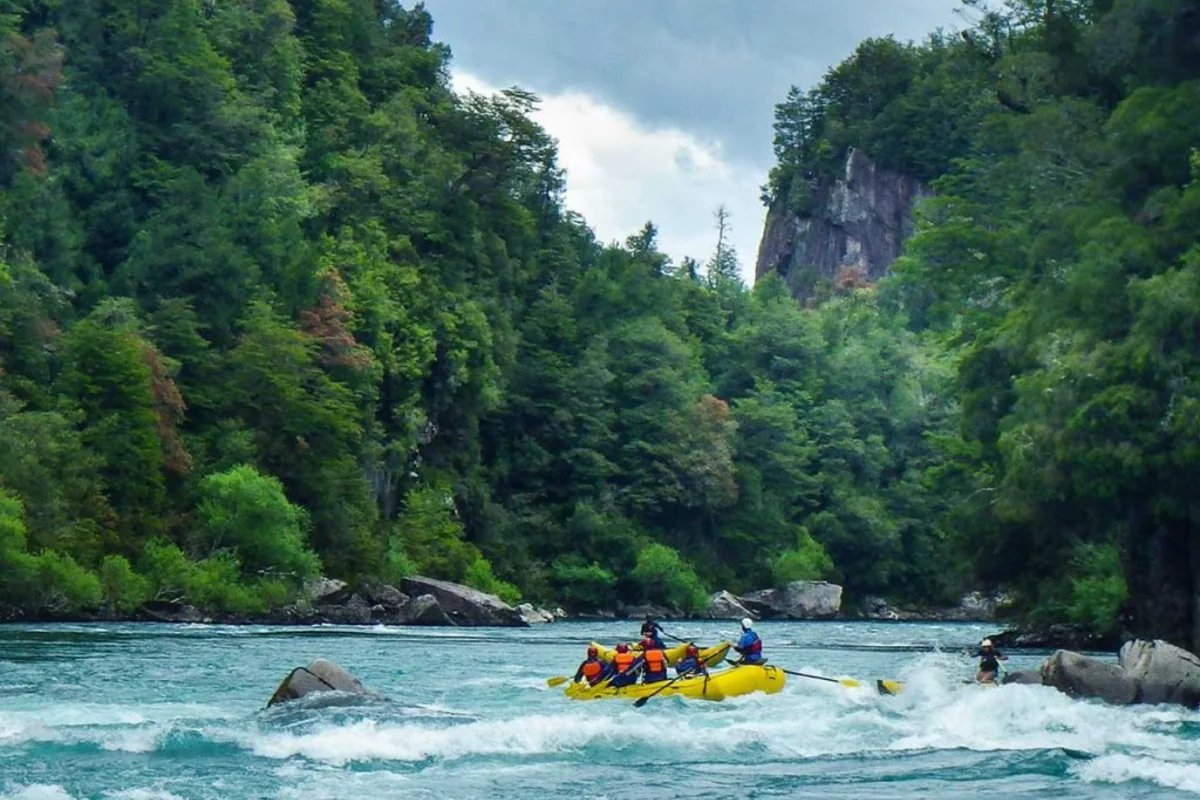
A four-night idea:
- Thursday, Feb 4: arrive, stroll the town, spa.
- Friday, Feb 5: half-day rafting or fishing. In the evening, check the forecast and pick your viewing spot.
- Saturday, Feb 6: eclipse at 11:55 a.m., long lunch, slow afternoon, and stars at night if it's clear.
- Sunday, Feb 7: a full day on the river, fishing or riding, before moving on Monday.
FAQ
FAQ
When is the 2027 annular eclipse in Chile?
Saturday, February 6, 2027, in the morning. In Futaleufú it begins at 10:22 a.m., the ring runs from 11:51 to 11:59 a.m., and it ends at 1:34 p.m., mainland Chile time (UTC−3).
Is Futaleufú inside the path of annularity?
Yes. Futaleufú sits almost on the centerline: about 2 miles south of it in town and 4 miles south at Uman Lodge. Annularity lasts about 7 min 31 s.
How long does the ring of fire last in Futaleufú?
About 7 minutes 31 seconds at Uman Lodge and 7 min 32 s on the centerline, based on our calculation from NASA's elements. timeanddate gives 7 min 30 s.
Is it a total eclipse?
No, it's annular. The Moon looks 7.5% smaller than the Sun and leaves a bright ring showing, so the sky doesn't go fully dark and no stars appear.
How much of the Sun is covered?
Inside the path, 86% of the Sun's area. Elsewhere in Chile the eclipse is partial: about 85% in Puerto Montt and about 61% in Santiago.
Can I look at the ring without glasses?
No. During an annular eclipse it's never safe to look at the Sun without an ISO 12312-2 filter, even with the ring complete. Sunglasses don't protect your eyes.
What time zone is Futaleufú in on February 6, 2027?
UTC−3, mainland Chile's daylight saving time, in force from September 2026 to April 3, 2027. Argentina is also on UTC−3, so Trevelin and Esquel show the same time.
Is it worth driving to the centerline?
Not for duration: from Uman Lodge you'd gain under a second. Move only if clouds cover the valley and the forecast is better elsewhere, such as Trevelin or Esquel.
What are the odds of clear skies?
Eclipsophile's satellite analysis puts average February cloud in Futaleufú at 52%, with the Sun visible on the eclipse date in at least 15 of 22 years. On the Argentine side, in Esquel, it drops to 40%.
Where is the best viewing in Argentina?
The centerline passes north of Trevelin and south of Esquel, with about 7 min 32 s of annularity, then crosses Chubut, Río Negro and the Buenos Aires coast. Trevelin is about 30 miles from Futaleufú via the Futaleufú Pass.
Is Uman Lodge planning anything for the eclipse?
We're working on a plan for the day: a viewing spot, glasses for guests, and options if it's cloudy. [CONFIRM] Message us for updates and book early.
What else can I do in Futaleufú in February?
February is rafting and fly fishing season, with long, mild days. There's also hiking, horseback riding, the spa, and moonless nights for stargazing.
Last word
An eclipse to remember the valley by
Some eclipses you chase across continents; others come to you. The February 6, 2027 eclipse passes right over Futaleufú at the height of summer, with the Sun high and seven and a half minutes of ring. If the sky cooperates, you'll watch it from a terrace above the river. If not, you'll still have spent a few days in one of Patagonia's most beautiful valleys.
Sources
- NASA/GSFC, Fred Espenak: Besselian elements, path table and interactive map. "Eclipse Predictions by Fred Espenak, NASA's GSFC".
- IMCCE (Paris Observatory): general circumstances and local circumstances calculator.
- Xavier Jubier: interactive map of the February 6, 2027 annular eclipse.
- timeanddate: eclipse in Futaleufú and global path.
- Jay Anderson, Eclipsophile: 2027 annular eclipse weather prospects.
- Los Lagos Regional Presidential Delegation: eclipse strategic committee, September 29, 2026 (Spanish).
- Library of the Chilean Congress: Supreme Decree 98 of 2026, official time (Spanish).
- Chilean Weather Service: Futaleufú Ad. station normals. Temperatures: atmosfera.cl, southern Chile climate data (Spanish).
- Mallamaci, Faculty of Astronomical and Geophysical Sciences (UNLP): Annular solar eclipse, February 6, 2027 (Spanish).
- American Astronomical Society: how to view a solar eclipse safely and filters for optics. NASA: eclipse safety.
- Roads: © OpenStreetMap contributors. Map coastline and borders: Natural Earth.